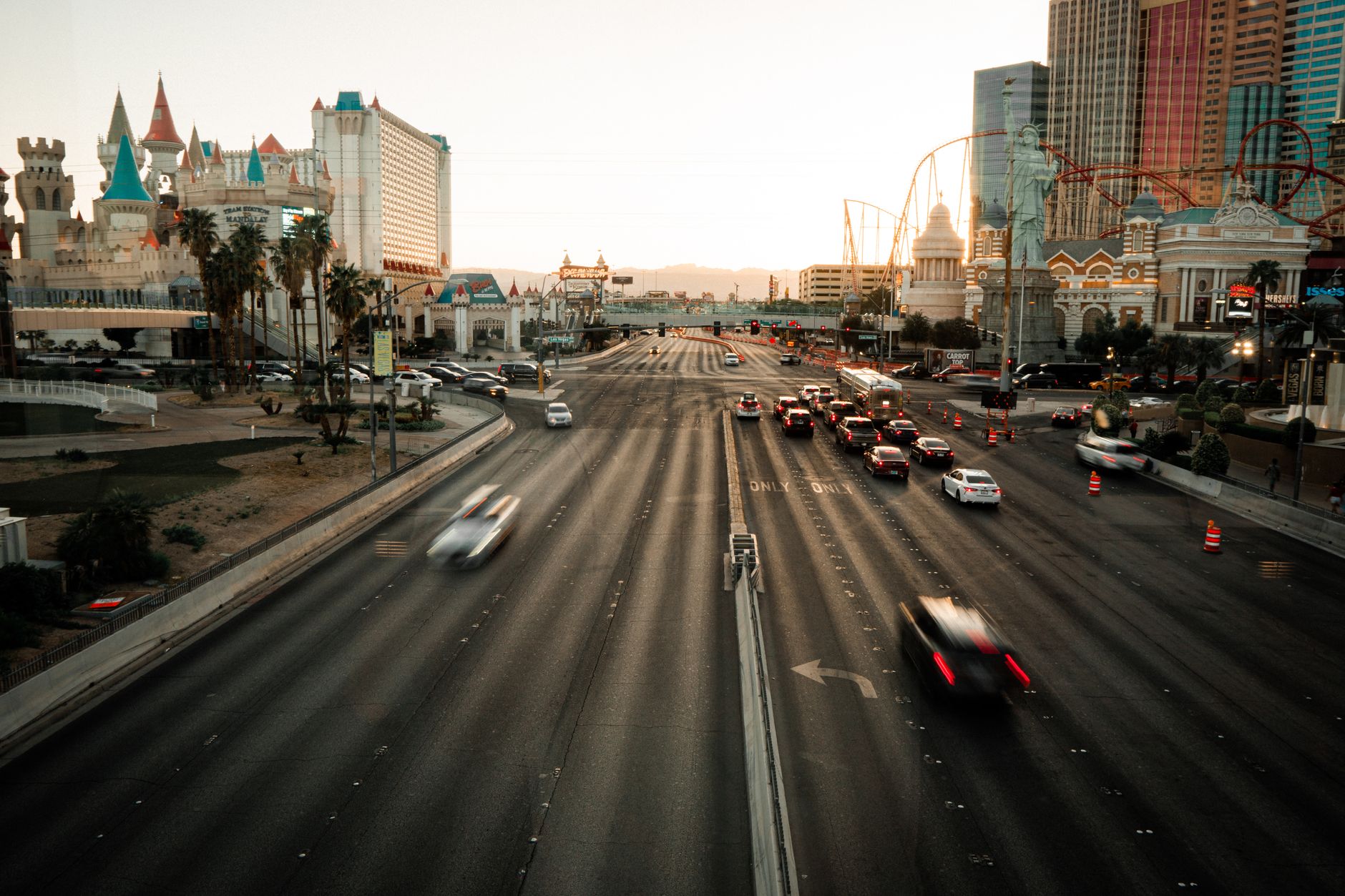
In Vegas
The Strip and downtown Fremont are heavily policed and safe on foot until 2am. After that, stick to the well-lit main drags. Do not walk east of Las Vegas Boulevard past Sahara Avenue at night — the neighborhoods change quickly. Pedestrian bridges at major intersections (Tropicana, Flamingo, Spring Mountain) are required by law and skipping them gets you a $200 jaywalking ticket. Costumed performers on the Strip expect $5 to $10 for a photo; agree first or walk on. Casino security officers patrol every gaming floor around the clock, and flagging one down is often faster than calling 911 for anything short of a medical emergency.
Hotel security is tight on the Strip: key-card elevators, staffed security desks on high floors at properties like Bellagio and Wynn Las Vegas, and cameras everywhere mean theft from rooms is rare. The bigger risk is unattended bags at the pool or the sportsbook, so keep valuables in the in-room safe. For rideshare pickup at the airport, use the marked zone at Terminal 1, level 2M, or Terminal 3's designated curb — never accept a ride offered inside baggage claim. On the Strip itself, Uber and Lyft pickup points are marked at each resort's valet entrance, which is safer and faster than hailing along the boulevard.
On the road and in the desert
Cell service disappears on US-50, US-93 north of Ely, and inside the national parks. Tell someone your route, carry 4 liters of water per person, and never leave the road on foot in summer. If your car breaks down, stay with it. Flash floods are real in slot canyons — check the forecast for Valley of Fire and Death Valley before you go. Rattlesnakes are around from April to October; watch where you put your hands on rocks. US-50 across the Great Basin is nicknamed the Loneliest Road in America, and gas stations can be 80 miles apart between Austin and Ely, so fill the tank whenever it dips below half.
Winter brings a different hazard: Interstate 80 over the Sierra near Truckee and US-395 through the eastern Sierra both close or require chains during storms between November and April, and Nevada Highway Patrol will turn back vehicles without snow tires. Mount Charleston, about 35 miles west of the Strip on State Route 157, drops below freezing while Las Vegas stays warm, so pack a jacket if you are driving up for the day. Elk and mule deer cross US-93 and US-50 at dawn and dusk; slow down on open-range sections marked by cattle-guard signs. Wildfire smoke can blanket Reno and Lake Tahoe in August and September, so check the AirNow index before a hike.
Money, ATMs and street scams
Casino ATMs charge a withdrawal fee of $3 to $5 on top of whatever your home bank charges, and the on-screen currency conversion offer is always worse than declining it. Use a bank-branded ATM inside a Bank of America or Wells Fargo branch near the Strip instead of the machines on the casino floor. Discount ticket booths along Las Vegas Boulevard mark up show tickets 20 to 40 percent over the box office or the venue's own website; buy Cirque du Soleil or headliner tickets directly rather than from a street kiosk. Street vendors selling "free" show passes near Fremont Street are almost always fronting a timeshare tour.
That timeshare pitch is Nevada's most persistent tourist scam: a promoter offers two free tickets or a discounted show in exchange for sitting through a 90-minute presentation that routinely runs past two hours with real sales pressure. If you have no interest in buying, decline at the sidewalk rather than starting the tour. Panhandlers around the Strip sometimes work with a partner who distracts you while a bag disappears from a chair; keep bags on your lap or looped around a table leg at outdoor bars. Count change handed back at gift shops and off-Strip liquor stores, where short-changing tourists is an occasional problem.
Reno, Tahoe and rural Nevada
Reno and Sparks are quieter than Las Vegas but not risk-free: the Truckee River corridor through Midtown and downtown is well used by day, but the older motel strip near 4th Street is best avoided after dark. Virginia City, about 25 miles south on State Route 341 over Geiger Grade, has steep unlit boardwalks and old mine shafts fenced off the highway; stay on marked paths and skip exploring tunnels, which can collapse without warning. Around Lake Tahoe, the South Shore casino strip near Stateline is safe on foot, but rental cabins near the Heavenly Mountain Resort area should have doors and windows locked overnight against black bears foraging in trash bins from May to October.
Rural Nevada runs on longer distances and thinner services: Elko, the largest town on I-80 between Reno and Salt Lake City, sits roughly 290 miles from Reno with only a handful of fuel stops in between, and Ely on US-50 can be over 60 miles from the next gas station. Small-town sheriff's offices cover huge counties, so response times to an isolated breakdown can run well over an hour. Carry a paper map or download offline maps before you leave cell coverage, and treat a full tank as the default, not the exception, once you are off Interstate 15 or Interstate 80.
Know the law
Nevada's minimum gambling and drinking age is 21, checked strictly at casino cage cash-outs and bar entrances alike; a passport or state ID is the only accepted proof for visitors, since photocopies are refused. Recreational marijuana is legal to buy at licensed dispensaries for anyone 21 and over, but smoking or vaping it in public — including on the Strip, in a car, or in most hotel rooms — remains illegal and can carry a fine. A handful of licensed cannabis consumption lounges, including ones near the Sahara corridor, are the only legal place to use it outside a private home. Crossing state lines with cannabis, even into California, is a federal offense regardless of either state's local law.
Nevada allows open carry of a firearm without a permit for anyone 18 or older who can legally own one, though concealed carry requires a permit that out-of-state visitors rarely hold reciprocity for; casinos post their own no-weapons policies at the door regardless of state law. Public alcohol consumption is legal only inside the marked pedestrian zones of the Strip and the Fremont Street Experience, in plastic or aluminum containers under 32 ounces — carrying an open glass bottle anywhere, or any open container in a moving vehicle, is a citable offense statewide.
Health, altitude and emergencies
Dial 911 for any emergency; Las Vegas's major trauma centers are University Medical Center and Sunrise Hospital, both a short ambulance ride from the Strip, while urgent-care clinics handle minor injuries and dehydration without an ER wait. Humidity in Las Vegas often sits below 10 percent, so headaches and nosebleeds from dehydration are common even for travelers who feel fine; buy water at a CVS or Walgreens rather than the hotel minibar, where prices run several times higher. Reno sits at roughly 4,500 feet and South Lake Tahoe near 6,200 feet, high enough that visitors flying in directly from sea level sometimes feel short of breath on their first hike; take the first day at altitude easy and drink more water than usual.
Good to know
Questions, answered
Is Las Vegas dangerous for tourists?
The Strip and Fremont Street have low violent-crime rates for tourist areas. The main risks are pickpocketing in crowds and rideshare or ATM scams.
Are the airport rideshare drivers legit?
Only use official Uber or Lyft from the marked rideshare zone at Terminal 1 level 2M. Do not accept rides from people offering them at baggage claim.
How real is desert heat as a danger?
Very. Death Valley kills unprepared hikers most summers. Never hike after 9am in July or August, and always carry more water than you think you need.
Can I open-carry alcohol in Vegas?
Yes, on the Strip and Fremont Street, but not in glass containers and not in a car. It is illegal statewide outside those pedestrian zones.
What should I know about marijuana laws as a visitor?
Dispensaries can sell to anyone 21 or over with ID, but public consumption is illegal everywhere except licensed lounges. Do not smoke in your rental car or hotel room, and never carry it across the California or Arizona state line.
Is it safe to drive rural highways like US-50 or US-93?
Yes, but plan around the distances: fuel stops can be 60 to 80 miles apart, and cell service drops for long stretches. Tell someone your route, keep the tank topped up, and carry extra water in case of a breakdown.
Doing good is the business: every booking through Stay Nevada funds one verified tonne of carbon removal — same room, same price, no markup.
Search stays